


A new oil tank is only as good as the base it sits on.
Many homeowners focus on the tank itself: cracks, fading, leaks or bulging. That makes sense. But the base underneath the tank is often the part that decides whether the new installation will stay stable over time.
A poor base can put pressure on the tank, affect the pipework and shorten the life of the new tank. A good base keeps the tank level, supported and safer to use.
For oil tank base work or oil tank replacement, call Brian on 086 806 8776.
Not every oil tank needs a new base
A new base is not always needed.
If the existing base is level, strong, large enough and in the right position, it may be suitable for the new tank. In that case, the work may be straightforward: remove the old tank, check the support, fit the new tank and reconnect the system.
The problem is that many old tanks are sitting on bases that were never ideal, or bases that have weakened over time.
Blocks move. Timber rots. Slabs crack. Soil settles. Raised supports can become unstable. A tank may look fine from the front, but the support underneath may tell a different story.
Why the oil tank base matters
An oil tank carries a lot of weight when full.
If the support underneath is uneven or too small, that weight is not spread properly. Over time, this can put stress on the tank body.
That can lead to movement, distortion, pipework strain or early tank failure.
This is why the base should be checked during any domestic oil tank replacement, not treated as an afterthought.
Signs your oil tank base may be a problem
You should check the base if you notice:
- the tank is leaning
- blocks are loose or sinking
- the slab is cracked
- timber supports are soft or rotten
- the tank is not fully supported underneath
- the tank has moved from its original position
- the base is smaller than the tank footprint
- there are weeds, soil or debris building up around the support
- the outlet or pipework looks strained
A poor base is not always dramatic. Sometimes it is just slightly uneven or poorly supported. That can still matter when a new tank is fitted.
Raised oil tank bases need proper support
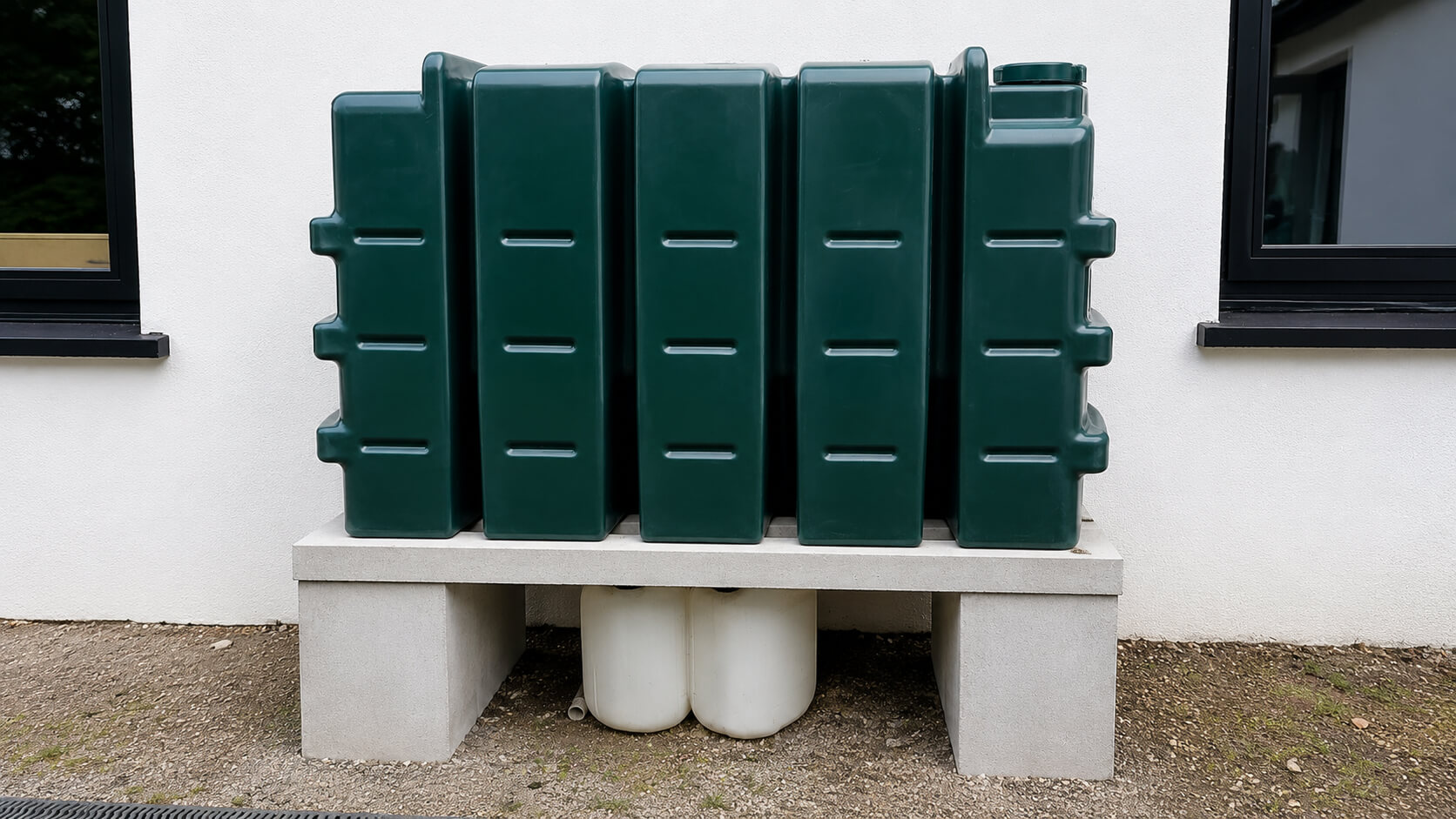
Many domestic oil tanks sit on raised block or concrete supports.
That can be fine if the base is built properly and gives the tank full, level support. The problem starts when the tank is sitting on scattered blocks, narrow supports or old timber that does not carry the weight evenly.
Raised tanks need to be stable.
If the tank is lifted off the ground, the support should be strong, level and suitable for the tank shape. It should not rock, sink or twist when the tank is full.
For base repairs or replacement, see oil tank base services.
The base must suit the new tank
A new tank may not have the same footprint as the old one.
Even if the old base looked acceptable, it may not suit the replacement tank. The new tank may be longer, wider, shorter, taller or shaped differently.
That is why the base needs to be checked against the tank being installed, not only against the tank being removed.
A base that is too narrow or too short can leave part of the tank unsupported. That is not a good start for a new installation.
For new tank options, see new oil tanks.
Poor access can affect base work
The base is not the only issue. Access matters too.
If the tank is behind a wall, shed, hedge, decking, side passage or tight garden area, it may affect how the old tank is removed and how the base is repaired or prepared.
This does not always make the job difficult, but it needs to be understood before work starts.
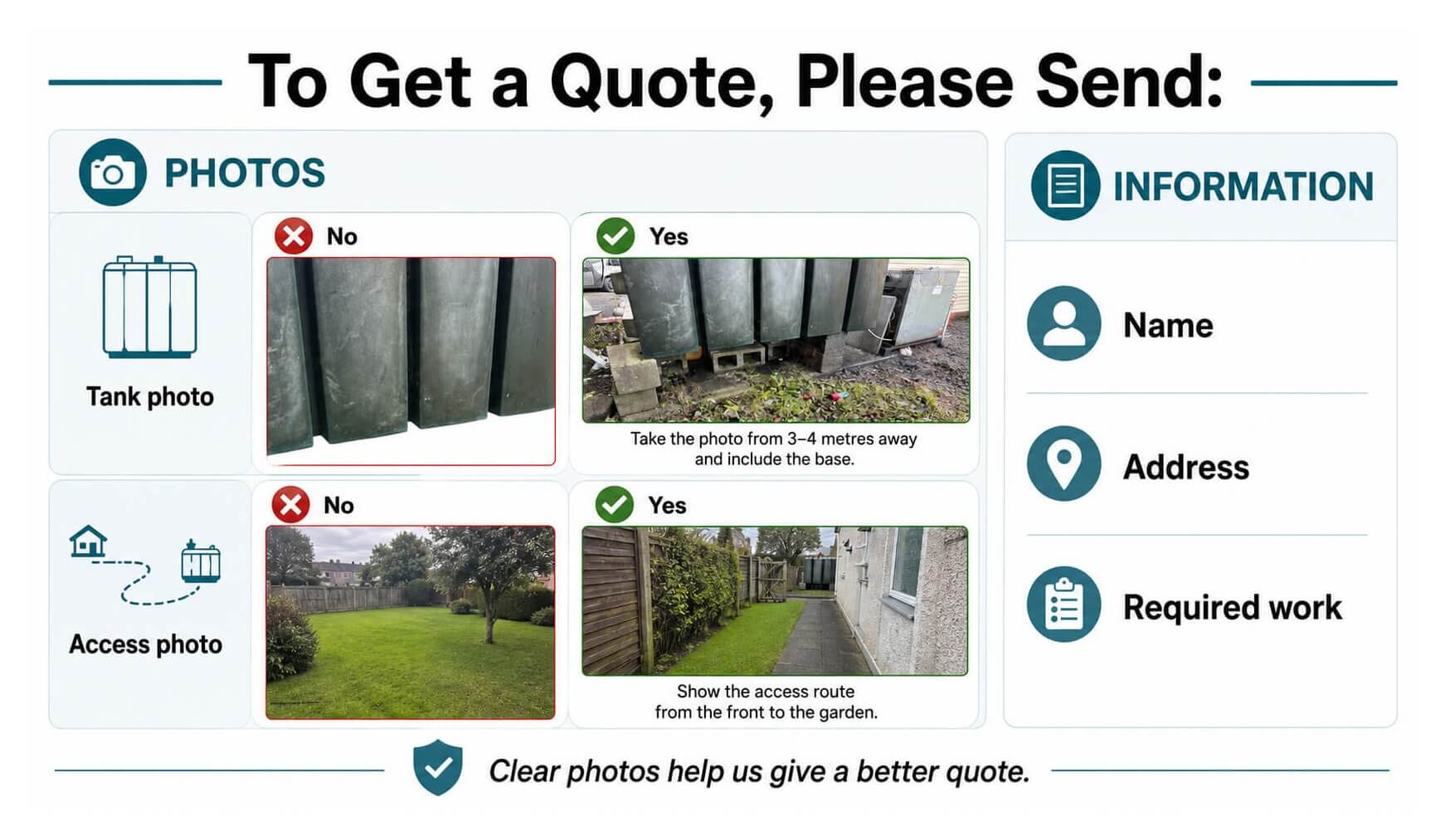
Clear photos of the tank, base and access route help give a better idea of what is involved before arrival.
Should you replace the base before the tank fails?
If the tank is already old, faded, cracked, bulging or leaking, the tank itself may need replacing.
If the base is also poor, it makes sense to deal with both together. There is no point fitting a new tank onto a weak or unsuitable base.
Doing the base properly during replacement gives the new tank a better chance of lasting as it should.
Can the old base be repaired?
Sometimes, yes.
Not every base needs to be fully rebuilt. In some cases, the existing support can be adjusted, repaired or improved. In other cases, the old support is too poor and a new base is the better option.
The right answer depends on the site, the tank type, the tank size and the condition of the existing support.
This is why photos are useful, but the final judgement may still need to be made on site.
What photos should you send?
Send clear photos of:
- the full oil tank
- the base underneath the tank
- the outlet and pipework
- both sides of the tank if possible
- the access route to the tank
- any leaning, cracking, sinking or poor support
A photo from too close will not show the full job. Step back and show the tank in its actual position.
For advice, call Brian on 086 806 8776.