


The cheapest tank is not always the right tank.
When replacing an old heating oil tank, many homeowners ask whether they need a single skin oil tank or a bunded oil tank. The answer depends on the property, the tank position, the surrounding area and the level of protection needed.
A good replacement is not just about choosing a tank that fits the space. The base, access, pipework, oil transfer and old tank removal all matter.
For oil tank replacement across Leinster, call Brian on 086 806 8776.
The simple difference between single skin and bunded oil tanks
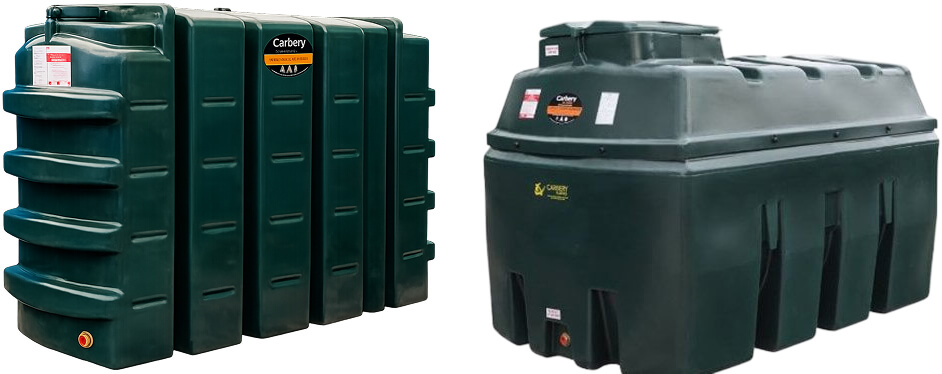
A single skin tank has one main tank wall.
A bunded tank has an inner tank and an outer protective layer. The outer layer gives extra protection if the inner tank ever fails.
That is the basic difference.
The right choice depends on where the tank is going, how much oil is being stored, what is nearby and whether extra protection is needed for the site.
For available tank options, see new oil tanks.
When a single skin oil tank may be suitable
A single skin oil tank may suit some domestic properties where the site is straightforward.
This usually means the tank can be placed on a proper base, away from obvious environmental risks, with good access and suitable pipework.
Single skin tanks are often chosen for standard domestic replacements where the old tank position is suitable and the site does not call for a higher level of containment.
But the site still needs to be checked. A single skin tank should not be treated as the automatic option just because the old tank was single skin.
When a bunded oil tank makes more sense
A bunded oil tank gives extra protection.
It is often the better choice where the tank is near drains, watercourses, sensitive ground, boundaries, busy areas or places where an oil leak would be harder to control.
It may also be preferred where the homeowner wants a stronger long-term setup.
A bunded tank is not only about the tank itself. It is about reducing risk around the property. That is why the position of the tank matters as much as the tank type.
The tank position can decide the answer
Two houses can need different tanks even if the heating system is similar.
One tank may sit in an open, simple area with good access and no obvious risk points nearby. Another may sit near a wall, drain, garden boundary, shed, decking or narrow side passage.
That second setup may need more thought.
Before choosing single skin or bunded, the tank position should be assessed properly. A poor position can turn a simple replacement into a more sensitive job.
For jobs where the tank position itself is the issue, see oil tank relocation.
The base still matters either way
A bunded tank on a poor base is still a poor installation.
A single skin tank on an uneven base is also a problem.
Whichever tank is chosen, it needs proper support. The base should be level, solid and suitable for the tank footprint. If the base is too small, cracked, unstable or badly built, it should be repaired or replaced before the new tank is fitted.
For more detail, see oil tank base work.
Replacing like-for-like is not always the best choice
Many homeowners assume the new tank should simply match the old one.
That is not always right.
The old tank may have been fitted years ago. The base may have moved. The garden may have changed. A shed, wall, drain, extension or patio may now be close to the tank. The old tank may also have been in the wrong place from the start.
A proper replacement looks at the current site, not only the old tank.
What about tank size?
Tank size depends on the property, heating use, space and access.
A larger tank may reduce how often you need deliveries, but it also takes up more space and carries more weight when full. The base must suit the size and shape of the new tank.
A compact tank may be better for tighter spaces, but it still has to work for the household and the installation area.
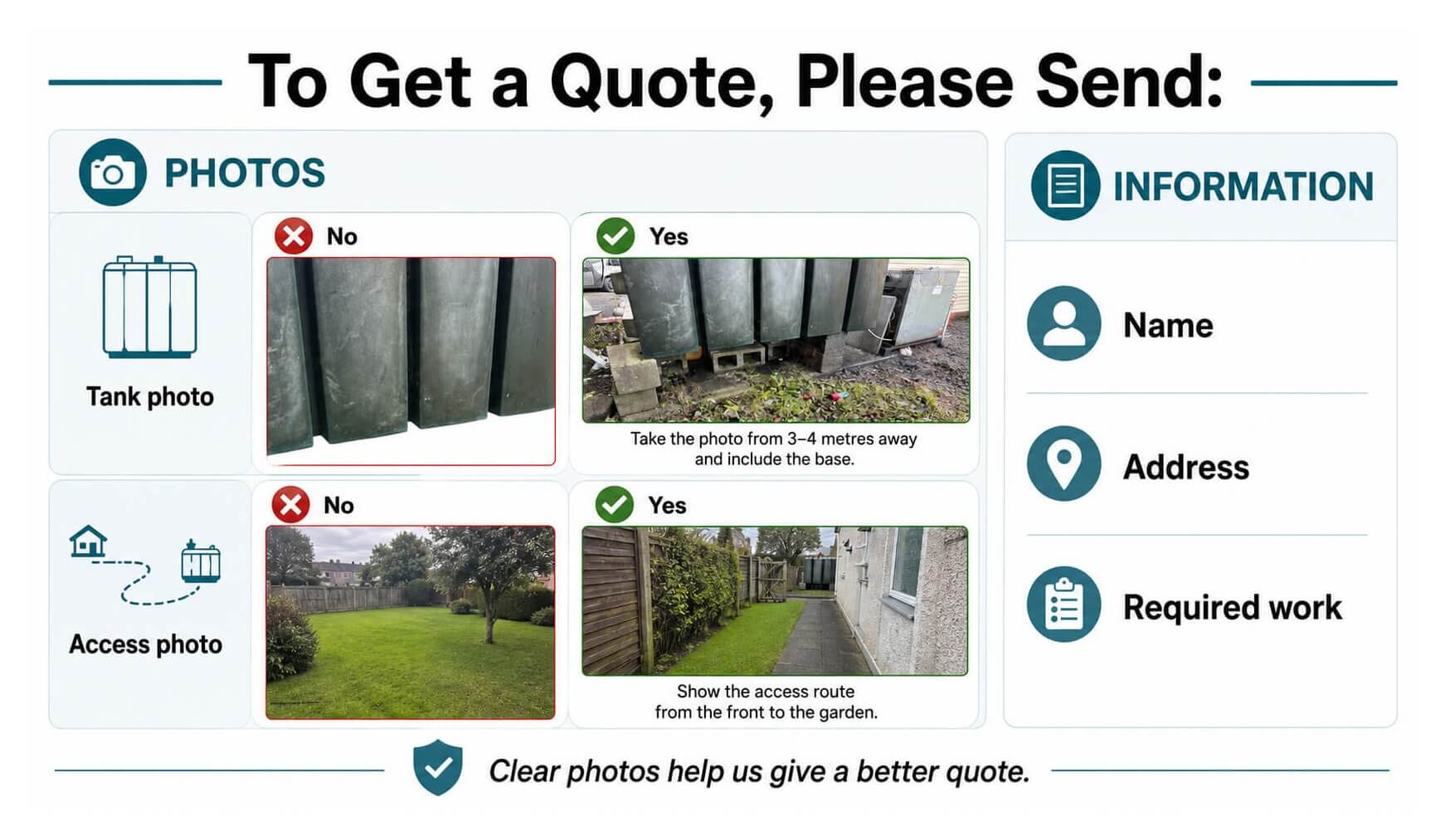
This is why photos of the tank, base and access route are useful before booking.
What happens to the oil during replacement?
If there is usable oil in the old tank, it can normally be pumped out and held safely during the job.
Clean oil can usually be transferred into the new tank where suitable. Sludge, water and dirty residue from the bottom of the old tank are kept separate.
This matters because dirty residue should not be put into a new tank.
For a full explanation, see what happens to the oil during oil tank replacement.
What happens to the old tank?
The old tank can be removed from site as part of the job.
That is important because old tanks often contain residue, sludge or contamination at the bottom. Leaving an old tank sitting in the garden is not a clean solution.
For tanks that are no longer needed, see oil tank removal.
Can cleaning solve the problem instead?
Sometimes tank cleaning helps, but it does not fix every issue.
If the tank has sludge or dirty residue, tank cleaning may be useful in some cases.
But if the tank is cracked, bulging, leaking, badly faded, unstable or sitting on a poor base, cleaning is not the real answer. The tank itself may need replacing.
Photos help choose the right tank
Clear photos make the first assessment easier.
Useful photos include:
- full tank
- base under the tank
- outlet and pipework
- access route
- nearby walls, drains, hedges or sheds
- visible cracks, bulging, staining or leaks
A close-up of the tank label can help, but it is not enough on its own. The full setup matters.
Single skin or bunded: the practical answer
A single skin tank may be suitable for a straightforward domestic setup.
A bunded tank gives extra protection and may be the better option where the location carries more risk.
The correct answer depends on the property, not a generic rule. The tank, base, access, pipework and surrounding area should all be considered before choosing.
Oil tank replacement across Leinster
For advice on the right tank for your property, call Brian on 086 806 8776